 Skip to main content
Blue Projects: The End‑to‑End Brewery Partner for Scalable, High‑Performance Production
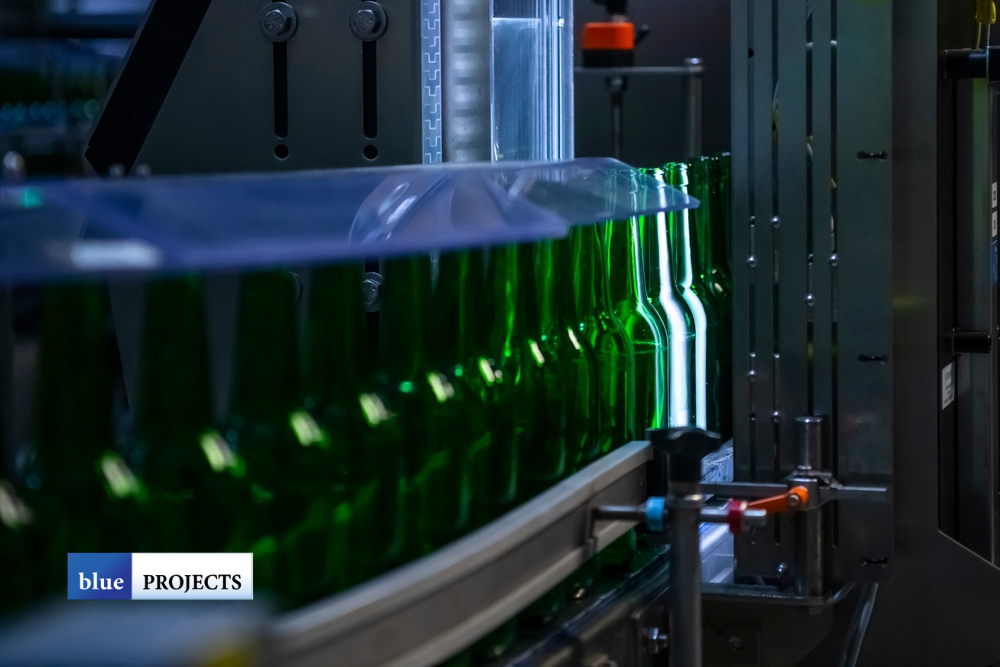
Modern brewery projects are complex systems that require alignment between process engineering, utilities, automation, procurement, construction and commissioning. At Blue Projects, we deliver this integration through a fully coordinated end‑to‑end approach. Our teams work across all project stages — from early capacity modelling and conceptual design to execution, start‑up and handover — ensuring that every decision supports constructability, operability and long‑term performance.
By combining multidisciplinary engineering with project management, vendor coordination and commissioning expertise, we help clients reduce interfaces, accelerate timelines and bring new capacity online with greater predictability and control.
These crucial stages usually follow the workflow as follows:
- Site selection and Site Masterplanning
- Conceptual Design
- Basic Engineering and Design to Tender
- Detailed Design
- Operational Planning, Startup and Execution
During Site Masterplanning, Blue Projects leads the multidisciplinary coordination needed to define capacity, utilities, layout and long‑term expansion logic. This stage anchors scope, budget and schedule, and is managed through our established change‑control procedures. This Stage Gate allows the team to anchor the scope, budget, timing and schedule and is managed by Blue Projects change control procedures thereafter. A work breakdown structure (WBS) is created at the start of the project to identify project battery limits and interfaces, and a contract strategy can be developed to align with the WBS. The SMP stages includes multidisciplinary coordination by the project manager to seamlessly integrate the project technical specifications to produce a site masterplan layout, pre-engineering design and finally basic engineering design. These teams are also supported fully by our planning, commercial and project management teams.
Our teams perform detailed capacity planning for existing breweries and maltings plants, analyzing recipes, seasonality and demand to identify bottlenecks in process and utilities. This modelling helps determine whether expansion is required and where constraints occur. Existing data is gathered and analysed in accordance with product recipes, seasonality and supply demand. This information is used to develop a capacity model that can map the consumption of the raw materials and utilities in each business unit of the plant. This helps to determine if the existing plant requires expansion and identifies where the bottleneck lies.
In the basic engineering stage, Blue Projects develops the process model that defines raw material intake, equipment sizing, utilities requirements and brewhouse configuration. Using industry benchmarks, our engineers design each process area for optimal utilization and efficiency. Breweries develop their plants based on production demand or trends and market growth and this is important to consider when designing brewhouse configurations, brew length and frequency. By using industry benchmarks, we can ensure design each process area to achieve optimal utilization and product efficiency. These defining factors are used to create tender packages in which suppliers are engaged for equipment supply and delivery. Once a supplier has been appointed, the integration between supplier, project integrator and client is crucial to successfully meet client expectations. In this phase, the following deliverables can be expected:
- Development of detailed Process Flow diagrams and Piping and Instrumentation diagrams (includes all aspects of the processing plant).
- Hazard and Operability studies as well as HACCP and HAZID.
- Equipment sizing
- Mass and energy balancing throughout unit operations.
- Finalizing of equipment lists (including equipment data sheets) as well as general plant layouts
- Clearly defining the utility system requirements and capabilities
- Preparation of control system philosophies, specific interlock and plant protection conditions.
- Identifying instrumentation and automation requirements to enable PLC and SCADA integration.
During execution and commissioning, it is important to identify key start up requirements and prioritize systems. A successful commissioning timeline is set up considering input from individual disciplines and understanding of the process. Pre-commissioning activities such as mechanical completion checks, punch listing, line flushing, pressure testing, IO testing and calibration should be complete per system before cold commissioning activities start. Ideally, before all process systems are started up, utilities connections such as air, water and electricity, etc. must be tested and running. Priority for utilities can be as follows:
- Electricity- MV/LV systems, transformers, MCC’s, earthing and protection systems. If the electricity is not commissioned first then this does not allow the equipment to be energised during start up and testing.
- Water- Water is needed for cleaning, CIP and in the brewhouse
- Steam and condensate
- Refrigeration- Temperature control is critical for fermentation and wort cooling
- Compressed air- This is required for the automation systems and control valve actuators
- CO2 storage and distribution
- Wastewater and effluent
The next area of focus would be the automation and control systems. This requires PLC/SCADA commissioning, field IO testing and instrument calibration, loop testing, control and interlock testing and recipe system configuration. Once this is tested and there are no potential issues, the process systems can come online in a staggered and controlled way to ensure that all functionality is also tested before hot commissioning the systems.
An example of this would be to start up the CIP system first. Considering that the CIP plant is central and linked to most of the plant, this gives the commissioning team opportunity to test this large network. The CIP plant can also then be used for tank and pipe cleaning to ensure that the process equipment in of hygienic compliance before product is introduced to the system.
Once this is complete, the process systems can be cold commissioned with water in the following sequence:
- Raw Material Handling- this includes the conveying, malt intake and milling systems
- Brewhouse- mash tun, lauter tun, kettle, whirlpool, wort transfer
- Cellar- Fermenters and BBTs
- Filtration- kieselguhr/ membrane filtration
- Packaging- this will always be commissioned last and will require a stable product supply to be successfully commissioned
Once all the systems have been cold commissioned and punch list items have been resolved, then the process can be hot commissioned by running product through the system.
Delivering a brewery is ultimately about more than completing a sequence of engineering and commissioning steps. It is about ensuring that every system — from raw material intake to packaging — comes online safely, efficiently and in full alignment with the client’s production strategy.
At Blue Projects, our end‑to‑end approach brings together process engineering, utilities, automation, procurement, construction management and commissioning into one coordinated workflow. This integration reduces interfaces, accelerates decision‑making and supports a predictable start‑up, allowing breweries to scale capacity with confidence.